Arborline
UX DESIGN
STRATEGY
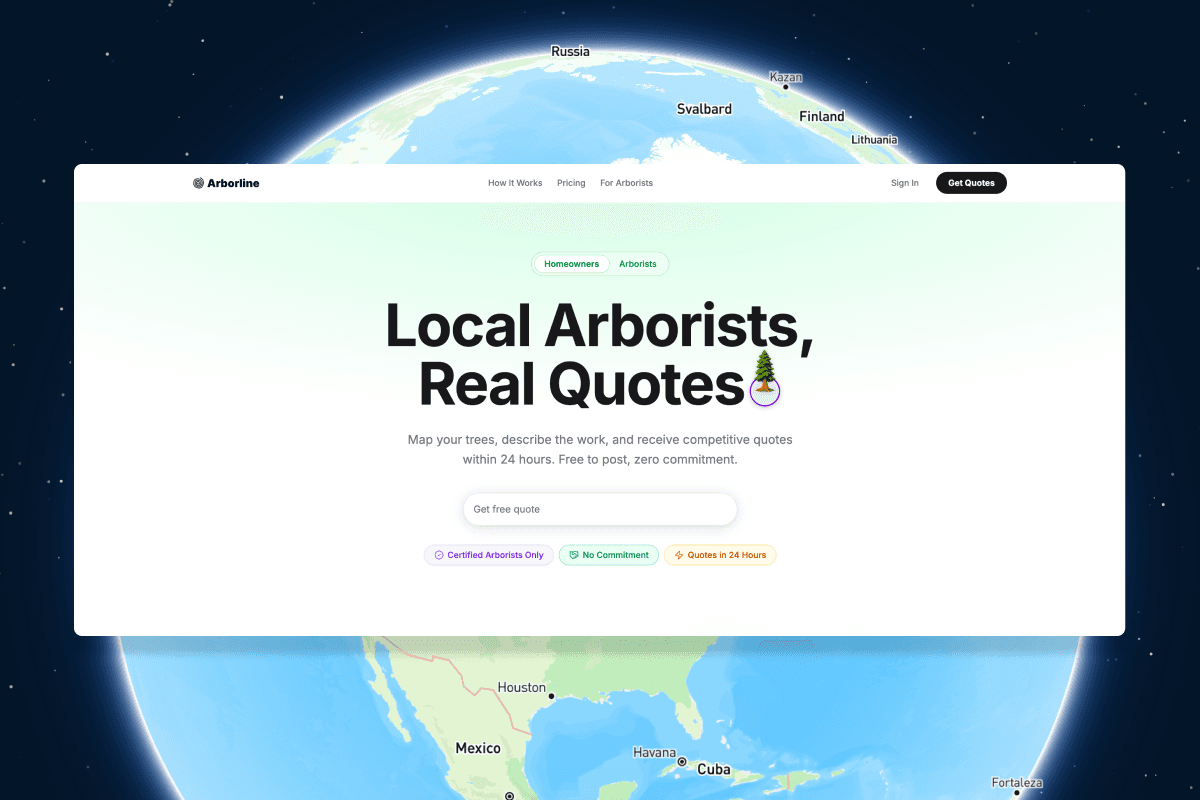
Overview
Arborline is a map-based quoting platform that helps homeowners visually define tree removal work and receive structured estimates from local arborists.
The idea came from a real project on my own property. After having roughly 20 trees removed, I realized that even with a great arborist, the process still relied heavily on loose descriptions, rough assumptions, and mismatched expectations around scope and cost.
I designed and built Arborline to explore whether a more visual, structured estimation workflow could reduce ambiguity for homeowners, improve quote quality for arborists, and create the foundation for a more scalable local services marketplace.
Role
Founder, Product Strategy, UX Design, AI-assisted Engineering
Timeline
Concept to working product in ~2–3 weeks
Focus Areas
0→1 product strategy
Marketplace UX
Service design
Visual estimation systems
AI-assisted product development
Business model exploration
The Problem
Tree removal is a high-cost, high-friction service where both sides often lack a clear shared understanding of the work.
For homeowners:
It is difficult to estimate cost upfront
Quotes often require multiple site visits
Pricing can feel opaque or inconsistent
Scope is hard to explain through text, calls, or photos alone
For arborists:
Many leads are unqualified or poorly scoped
Remote assessment is difficult without structured context
Estimates often require time-consuming site visits
Quote details can be scattered across texts, emails, photos, and notes
Core issue
There is no shared visual language for defining the work.
Last summer, I sent my arborist a rough drawing of my property to explain which trees I thought were part of the job. That drawing became the seed for Arborline: a way to turn informal, ambiguous scope-setting into a structured visual workflow.

The Insight
The opportunity was not simply to generate more leads for arborists.
The bigger opportunity was to create a shared estimation layer between homeowners and service providers.
If both sides can see the same map, the same trees, the same scope, and the same assumptions, the quoting process becomes clearer, faster, and more trustworthy.
Arborline turns a rough homeowner description into a structured, visual scope of work.
The Product
Arborline introduces a map-first estimation experience for tree removal.
Homeowners can:
Enter an address
Recreate their property on an interactive map
Place trees visually
Tag each tree by type, size, and work needed
Indicate whether stump removal is included
Receive a rough estimate range
Submit the job to local arborists
Arborists can:
Review the mapped scope
Understand job complexity before visiting the site
Add notes, assumptions, and pricing
Submit a structured quote back to the homeowner
Key Product Decisions
1. Map-first instead of form-first
Early exploration made it clear that homeowners struggle to describe outdoor work through text fields.
Tree removal is spatial. Location, proximity, slope, access, and grouping all matter.
So the experience shifted from a traditional form-based flow to a map-first interaction model where users could define scope visually.
Why it mattered
Reduced ambiguity
Made the experience more intuitive
Created a shared artifact between homeowner and arborist
Made the quote request feel more concrete and trustworthy
2. Progressive disclosure for complex input
Tree work has many variables: tree size, type, access, stump removal, equipment needs, risk, and proximity to structures.
Rather than exposing all of that complexity upfront, I used a progressive interaction model where the user starts with a simple action — placing a tree — and adds detail only when needed.
Why it mattered
Kept onboarding lightweight
Avoided overwhelming the homeowner
Supported more advanced estimation logic over time
Created a scalable pattern for future service categories
3. Estimate ranges instead of false precision
A major risk in this type of product is giving users a number that feels overly exact.
Tree removal pricing can vary based on access, equipment, risk, disposal, crew availability, and regional labor rates. A precise estimate would create false confidence.
Instead, Arborline uses estimate ranges and confidence indicators to set expectations without pretending the system knows everything.
Why it mattered
Built trust with homeowners
Preserved room for arborist judgment
Reflected real-world variability
Reduced the risk of misleading price expectations
4. Structured quote requests for arborists
The homeowner experience is only one side of the product. For Arborline to work, the arborist experience needed to feel useful rather than like another lead form.
The arborist view gives providers a structured request with visual context, tree-level details, and enough information to decide whether they want to quote, request more detail, or schedule a visit.
Why it mattered
Improved lead quality
Reduced wasted site visits
Made requests easier to evaluate remotely
Created a repeatable quoting workflow
5. Marketplace model built around completed value
I explored several monetization paths, including lead fees, premium listings, SaaS tools, and transaction fees.
The strongest model was a transaction-based service fee because it aligns Arborline’s revenue with completed work rather than raw lead volume.
Direction
A 5% service fee on completed jobs creates a cleaner value exchange:
Homeowners get easier quote comparison
Arborists get better-scoped opportunities
Arborline earns when the marketplace creates real value
From Prototype to Product
The initial concept started as a simple question:
Could a homeowner describe tree removal work more clearly with a map than with a form?
I explored several early directions:
Text-based quote request
Visual property builder
Static pricing model
Dynamic estimate ranges
Linear forms
Progressive map-based workflows
The key learning was that the map was not just an input method. It was the core product.
Once the tree placement interaction worked, the rest of the system had a foundation: pricing logic, arborist review, quote comparison, and marketplace mechanics could all be built around a shared visual scope.
AI-Assisted Build Process
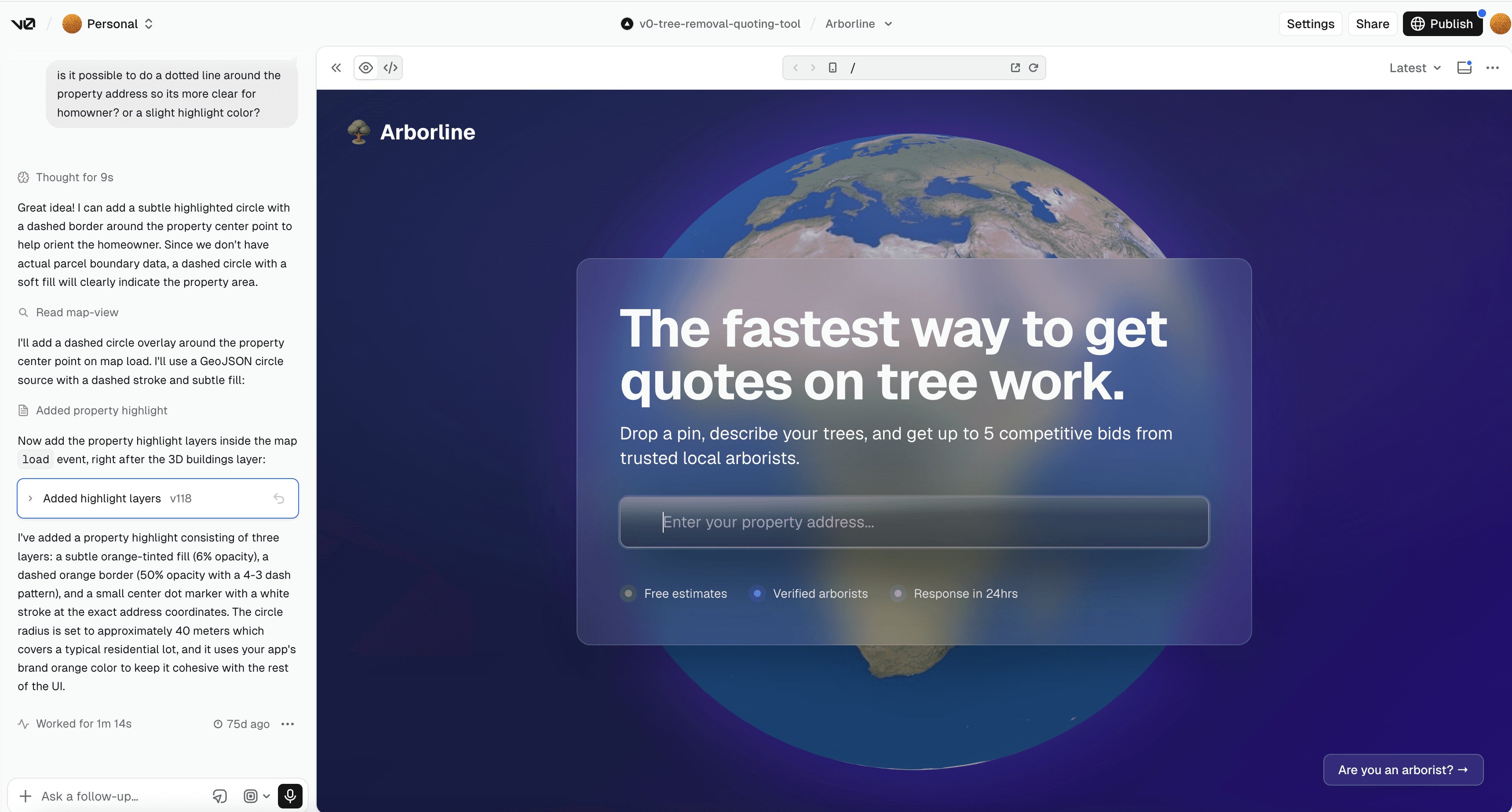
This project also became an exploration of how AI-assisted development changes the product design process.
I used AI tools to move from concept to working product quickly, while staying close to the design and product decisions.
Workflow
Started with V0 to quickly explore interface direction and flow
Moved into Claude Code inside VS Code for more control
Scaffolded a Next.js application
Built interactive UI components with Tailwind and shadcn
Integrated map-based interactions with Mapbox
Iterated on product behavior directly in code
Why this mattered
AI did not replace the product thinking. It compressed the distance between product strategy, UX design, and working software.
That allowed me to test interaction models, refine flows, and evaluate the business concept without waiting for a traditional team structure or development cycle.
Business Model Exploration
Arborline has several potential paths to monetization:
Lead fee per quote
Transaction fee on completed jobs
Premium arborist profiles
Territory-based visibility
Scheduling, quoting, and invoicing tools for arborists
Future SaaS layer for local service providers
The most compelling near-term model is a transaction fee on completed work.
This avoids the race-to-the-bottom dynamics of lead generation and instead positions Arborline as infrastructure for clearer scoping, better quotes, and completed jobs.
Outcome
In a few weeks, I moved from a real-world service problem to a working product prototype with both homeowner and arborist experiences.
What I built
Homeowner quote request flow
Map-based tree placement experience
Tree-level scope definition
Estimate range logic
Arborist review and quote flow
Initial marketplace and monetization model
What it validated
Homeowners benefit from a visual way to define outdoor service work
Arborists need better context before investing time in estimates
Map-based scoping can become a shared language between both sides
AI-assisted development can dramatically compress 0→1 product exploration
What This Demonstrates
Arborline is less about tree removal specifically and more about how ambiguous offline workflows can be redesigned into structured digital systems.
The project demonstrates my ability to:
Identify a real-world service design problem
Translate ambiguity into a product model
Design both sides of a marketplace
Build a working prototype using modern AI-assisted tools
Explore business model viability alongside UX
Move quickly from insight to execution
Reflection
This project changed how I think about early-stage product development.
The gap between idea, design, and implementation is getting smaller. For design leaders, that creates a major opportunity: we can move beyond static artifacts and use working software to test strategy, communicate vision, and validate product direction much earlier.
Arborline is an exploration of that shift.
It started with a rough drawing sent to an arborist.
It became a working product for turning unclear service requests into shared visual estimates.
Try it out: arborline.co